
leetcode vs AI assisted coding

Background
Erdos Research is primarily focused on reskilling non developers to AI assisted software development.
In this objective, systems like leetcode act as a limitation because they need to be adapted to an AI assisted coding world.
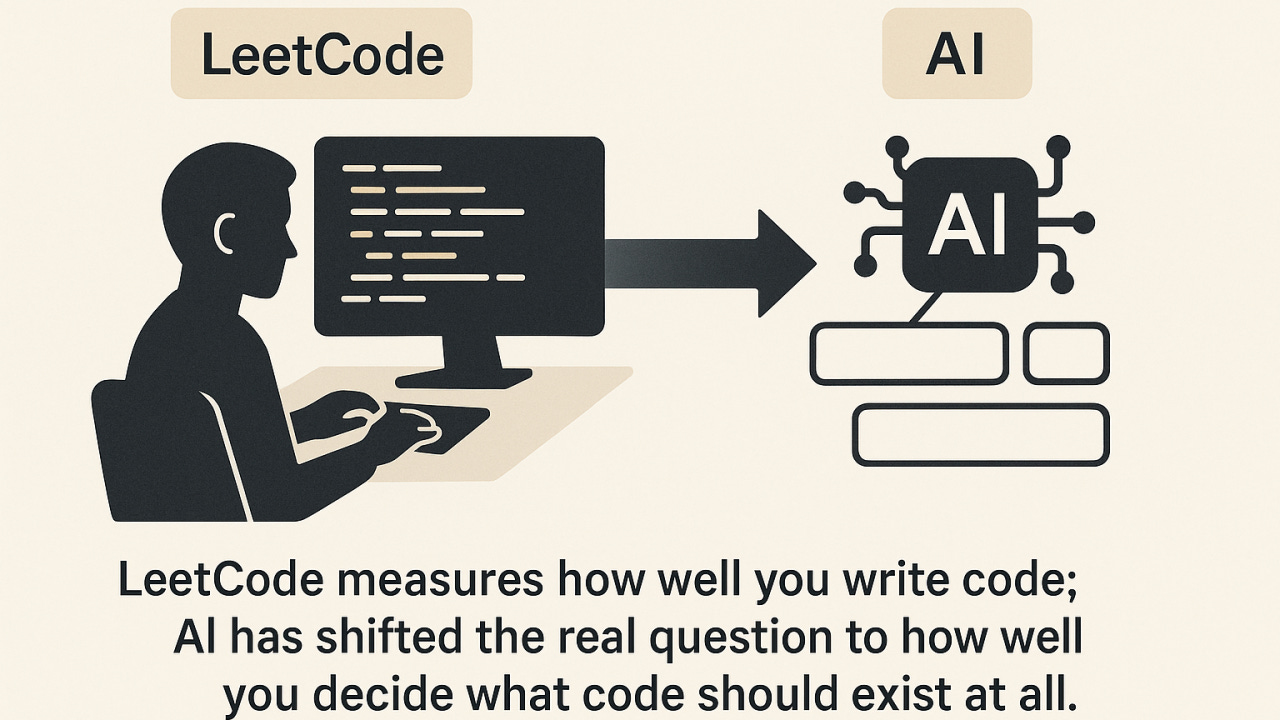
LeetCode measures how well you write code; AI has shifted the real question to how well you decide what code should exist at all.
When code is primarily AI-generated, systems like LeetCode, HackerRank, Codeforces, and similar platforms begin to show structural limitations. These platforms were designed for a human-coding era, not an AI-co-creation era.
These systems operate under the belief that good engineers are fast problem solvers who write correct code under time pressure. With AI assisted coding, this changes because AI writes syntactically correct code rapidly and consequently, humans increasingly act as specifiers, reviewers, and system designers.
In a world where AI assisted coding plays a significant part, we need to test more than the manual implementation of the code. We need to test for judgement, constraints, tradeoffs, and intent
By implication, that means we also need to test for:
Problem framing
Choosing the right abstraction
Rejecting incorrect AI outputs
Knowing when not to code
The Specification Layer is the new bottleneck
AI assisted code shifts the level of abstraction. In AI-assisted development, the hardest part is no longer the algorithm—it’s the spec. As we are all painfully aware, AI does not eliminate bugs—it changes their nature by introducing new modes of failure such as:
Subtle logical errors
Hallucinated APIs
Silent assumption violations
Correct code for the wrong problem
Security considerations are missing in code.
Consequently, we need to test:
Reviewing AI output critically
Stress-testing assumptions
Designing adversarial test
AI Engineering also needs to test aspects that do not appear in current testing such as Data pipelines, APIs, Distributed systems , Observability Cost, latency, reliability
Code Is no longer the scarce resource
Historically, code was expensive - thinking about code was not measured. Now, with AI assistance, code is no longer the scarce resource - so (human) thinking and judgement becomes the scarce resource - but that’s still not (yet) measured.
Another important characteristic thats not measured is human-AI collaboration.
In practice, engineers already now:
Co-create with AI
Iterate via prompt refinement
Maintain mental models across AI revisions
This needs some hard to articulate skills:
Prompting as specification
Steering AI without overfitting
Detecting when AI confidence exceeds correctness
Finally, they currently optimise for individual performance - not team collaboration - which becomes an important metric.
Implications
Systems like leetcode enforce the wrong hiring signal - especially if we acknowledge that AI writes most of the code.
LeetCode selects for
algorithm recall
short-term memory
speed under pressure
But industry now needs a different type of person
systems thinkers
product-aware engineers
AI supervisors
forward-deployed engineers
AI product managers
This creates a false negative problem because great real-world engineers and problem solvers fail interviews,
Finally, a personal perspective - AI is evolving asymmetrically (not everyone will agree I know) - but evaluation assumes symmetric collaboration.
Thus, current systems test for a world which is rapidly evolving because they are testing for the wrong bottlenecks
Ultimately, we need to assess new primitives
Spec-driven tasks
AI-review challenges
System design with AI in the loop
Evaluation of tradeoffs, not outputs
Ability to say “this solution is wrong—even if it runs”
Erdos Research is primarily focused on reskilling non developers to AI assisted software development. Please contact us at Erdos Research if you want to work with us